
Connect what is already there. No rip and replace, no capex.
A plug-and-play device next to your controllers reads them and passes writes back. Your services use one API for every building.
[03] Use it
One API for every building.
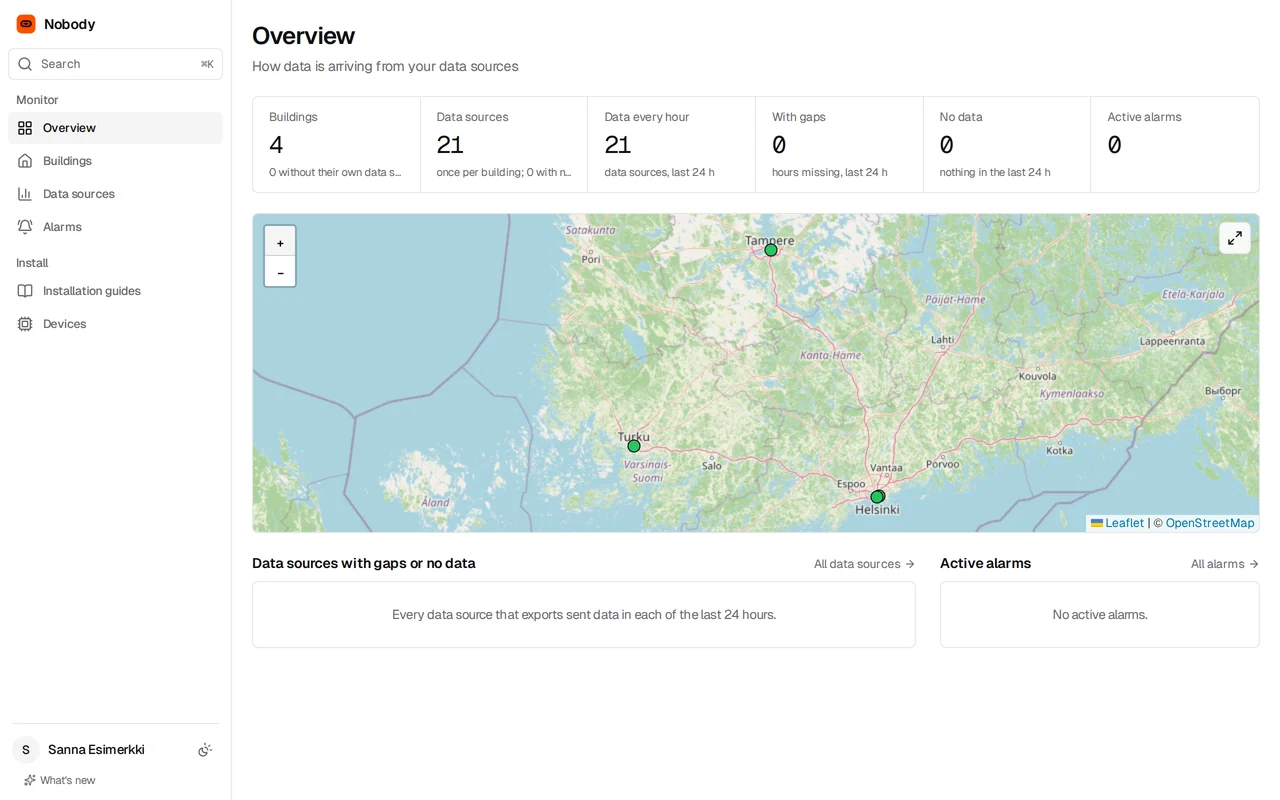
Every point gets the same structure, whatever the system. Read it over REST or MQTT, or look at it in the portal.
The details
What is the device?
One or more edge computing units (ECUs), depending on the systems and their complexity. They go into the automation cabinet, next to your existing controllers, and connect over their own 4G, over 4G on your own APN, or with no SIM card over your network. Connections are outbound only, never over Wi-Fi.
What does installation involve?
We work out the setup from photos and ship configured ECUs. Your technician mounts and connects them, and we commission them remotely. Data is flowing within hours of installation; a typical site is live in days.
What happens if a service stops writing?
Services can change values through the API. Each write carries a fail-safe restore value: if the service stops refreshing it, the ECU puts the building’s own value back. A built-in local watchdog runs on every ECU, so no vendor-coded failsafe is needed.
Are writes logged?
Yes. Writes go to the mapped point name, not the controller address, and each command is recorded with the identifier of the service that sent it.
How often are points read?
About every minute for the points your services use, hourly for the rest, and a daily scan so new points show up.
Where does it run, and is it secure?
All customer data stays in the EU/EEA. A Finland-only deployment is possible, and Nobody can also run fully on-premises in your own data centre. ECUs only make outbound connections, encrypted with TLS and mutual-TLS device certificates; you don’t open inbound ports or add firewall rules. ISO 27001 certification is in progress.
Can people reach the controllers remotely?
Yes. Time-limited portal sessions to a controller’s own web interface, or an on-demand VPN for an authorised system. No open ports either way.
Which outputs are there?
A versioned REST API, MQTT, a BACnet server (virtual BACnet device), and partner integrations maintained by Nobody.
Is there a version without an ECU?
With VPN access to your system, field agents can run in our cloud or yours. That is read-only; writes need an ECU.